%201.svg)


McKinney's Smart Choice: Investing in an Energy-Efficient Furnace
November 10, 2025
Why McKinney Homeowners Are Making the Switch
High efficiency furnace McKinney TX systems are changing how local homeowners heat their homes while dramatically reducing their monthly energy bills. If you're searching for a reliable heating solution that combines comfort with cost savings, here's what you need to know:
Quick Guide to High-Efficiency Furnaces in McKinney:
- AFUE Rating: Look for 90%+ (converts 90+ cents of every dollar into heat)
- Expected Savings: Up to 50% reduction in heating costs vs. older models
- Typical Lifespan: 15-20 years with proper maintenance
- Best For: Homes with furnaces 15+ years old or rising utility bills
- Local Benefits: Consistent warmth during McKinney's unpredictable winter temps
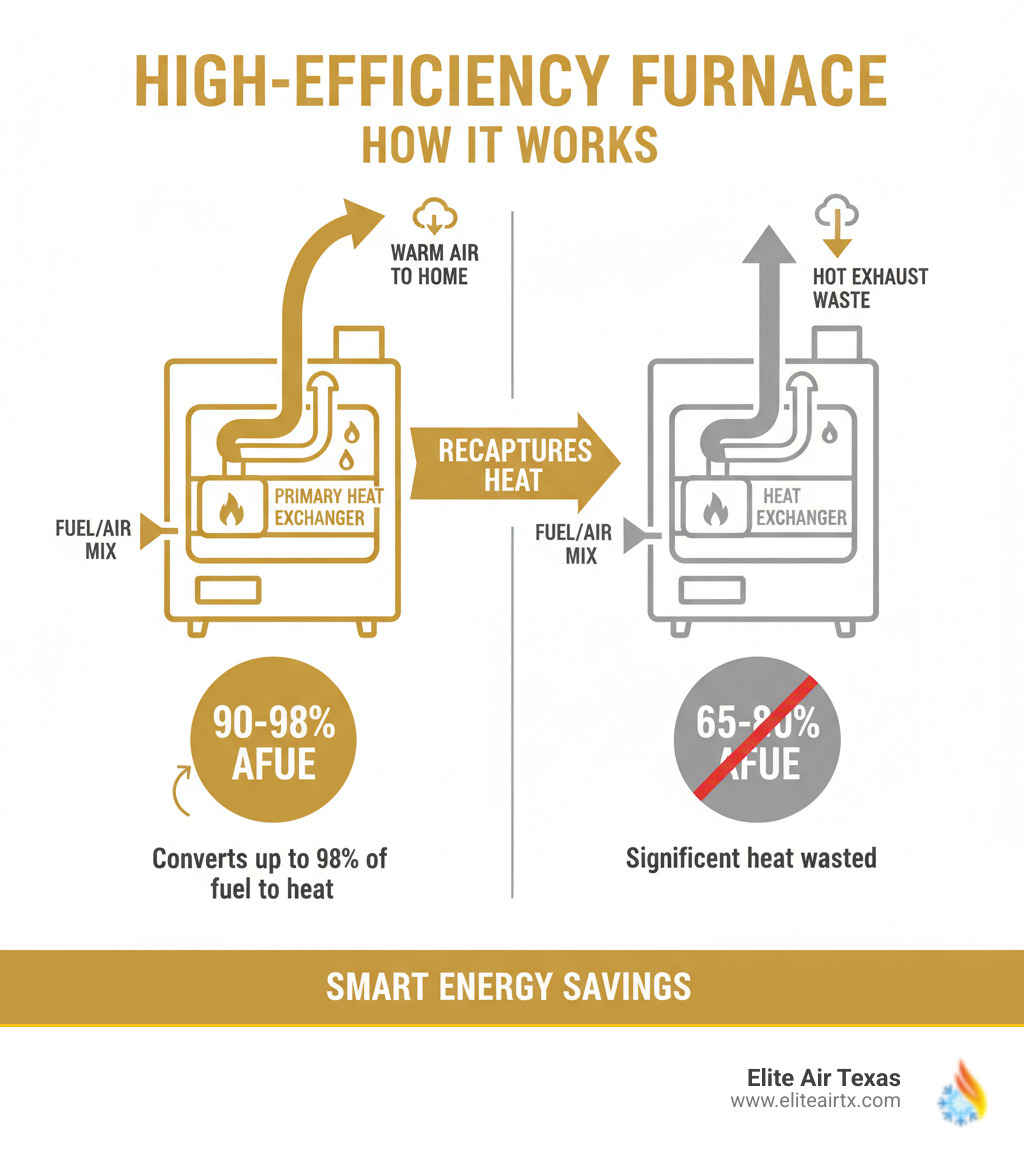
McKinney winters might not match Minnesota's deep freeze, but when temperatures dip below freezing—which happens regularly from December through February—you need a furnace that works efficiently without breaking the bank. The reality is that many McKinney homes still rely on outdated furnaces with efficiency ratings of just 65-80%, meaning a significant chunk of your heating dollars literally goes up the chimney.
Modern high-efficiency furnaces operate fundamentally differently. They capture and reuse heat that standard furnaces waste, converting 90-98% of fuel directly into warmth for your home. This isn't just about saving money—though that's a major benefit. It's about consistent comfort, fewer repairs, quieter operation, and reducing your environmental impact.
With energy costs continuing to rise and McKinney's climate presenting both hot summers and surprisingly cold winter nights, upgrading to a high-efficiency furnace represents one of the smartest home investments you can make. The technology has advanced significantly, offering features like variable-speed blowers and multi-stage heating that older systems simply can't match.
What Makes a Furnace "High-Efficiency"?
If you've been shopping for a new furnace, you've probably seen the term "high-efficiency" thrown around quite a bit. But what does it actually mean? The answer comes down to one important number: the AFUE rating.
AFUE stands for Annual Fuel Utilization Efficiency, and it's the measuring stick for how well your furnace converts fuel into actual heat for your home. Think of it like gas mileage for your car—except instead of miles per gallon, you're looking at heat per dollar spent.
Here's how it works in real terms: if your furnace has a 65% AFUE rating, only 65 cents of every dollar you spend on fuel actually heats your home. The other 35 cents? It's literally going up in smoke, escaping through your exhaust vent. That's money you're spending to heat the great outdoors.
Now compare that to a modern high efficiency furnace McKinney TX homeowners are installing today. These units typically have AFUE ratings of 90% or higher—some even reach an impressive 98.5%. That means almost every penny you spend on heating actually keeps your family warm. The difference in your monthly utility bills can be substantial, especially during those cold snaps we get in North Texas.
So what's the secret sauce that makes these furnaces so much more efficient? It all comes down to how they handle the combustion process, particularly the difference between standard furnaces and condensing furnaces.
Your traditional furnace burns fuel, creates heat, and sends the hot exhaust gases straight out through a metal chimney. It heats your home, but it's also sending a lot of valuable heat energy right out the roof. It's like leaving money on the table—or in this case, floating away into the McKinney sky.
High-efficiency condensing furnaces take a smarter approach. First, they use a sealed combustion system that pulls in fresh air from outside for burning fuel, rather than using the air you've already paid to heat inside your home. This alone improves both safety and efficiency.
But the real magic happens with the secondary heat exchanger. After the initial combustion, the exhaust gases are still carrying a lot of heat. Instead of wasting it, the secondary heat exchanger captures those gases and cools them down so much that the water vapor inside actually condenses into liquid. This process releases even more heat—called latent heat—which gets transferred into your home.
It's brilliant when you think about it. The furnace is essentially squeezing every last bit of warmth out of the fuel before anything leaves your house. That's how these systems extract so much more heat from the same amount of natural gas or propane.
Key Differences from Standard Furnaces
Once you understand how a high-efficiency furnace works, the practical differences start making a lot more sense. You'll notice several things that set these systems apart from older models.

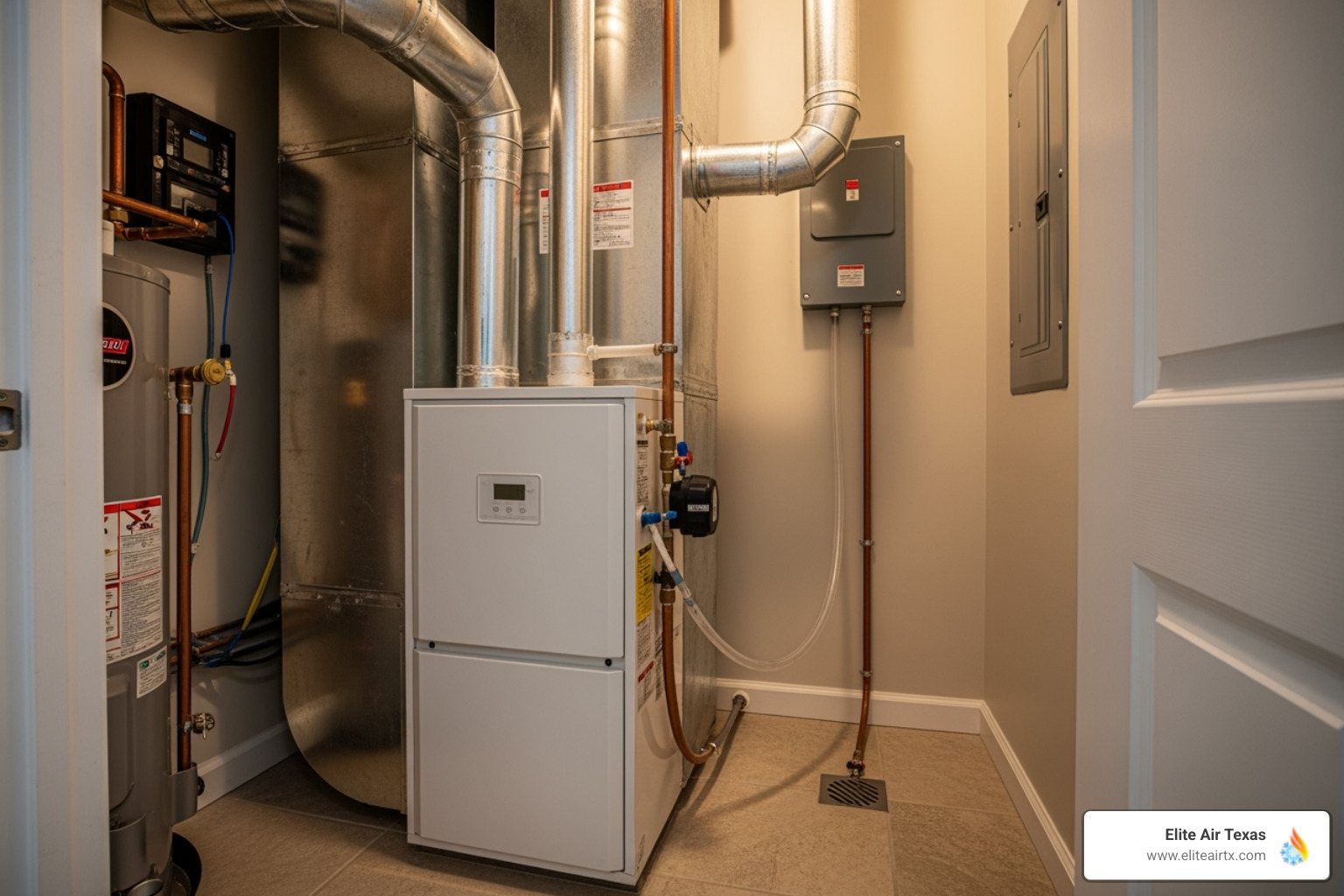
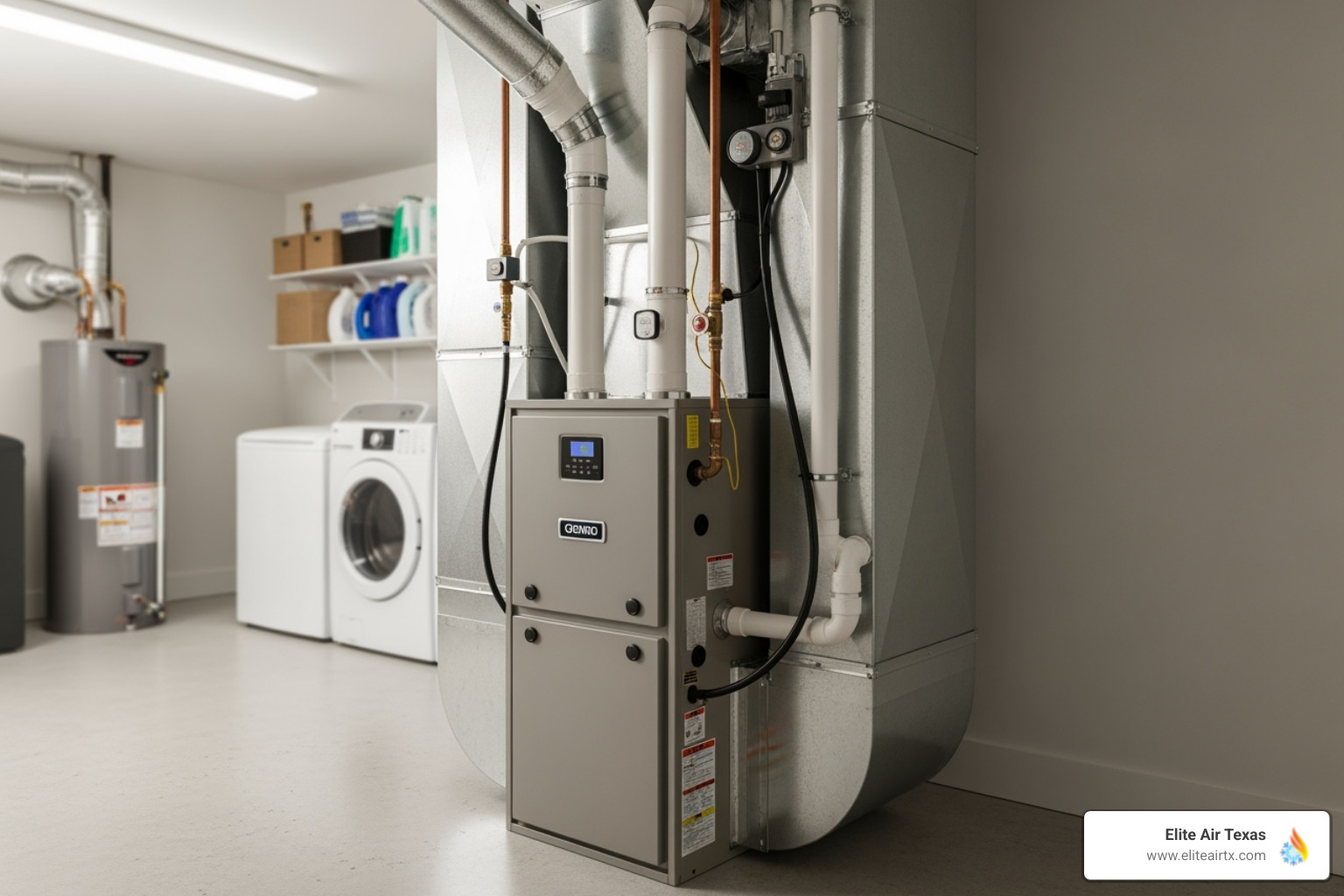
The most obvious difference? The venting materials. Walk around your McKinney neighborhood and look at the exhaust vents on homes. If you see white PVC pipes coming out of the side of a house, you're looking at a high-efficiency furnace. Standard furnaces need metal flue pipes because their exhaust is so hot it would melt plastic. But high-efficiency units cool those gases down so much that PVC works perfectly fine—and costs less to install.
This switch to PVC venting is more than just a cost-saver. It's visual proof of just how much fuel waste reduction these systems achieve. When your exhaust is cool enough to go through plastic piping, you know you're not sending expensive heat up the chimney.
You'll also find a condensate drain line on every high-efficiency furnace. Water vapor we mentioned condensing inside the secondary heat exchanger? That water has to go somewhere. The drain line carries it away to a floor drain, sump pump, or outside. It's completely normal—in fact, if you have a condensing furnace and aren't seeing any condensate, that might indicate a problem worth checking out.
Here's a bonus that homeowners really appreciate: high-efficiency furnaces typically run much more quietly than older models. The sealed combustion system keeps operational noise contained, and modern blower motors (especially variable-speed models) operate at a whisper compared to the old single-speed motors that would kick on with a bang. No more conversation-stopping roar when the heat kicks in during dinner.
For McKinney families, these differences add up to a heating system that's not just more efficient on paper, but genuinely better to live with day after day. Lower bills, consistent warmth, and peaceful operation—that's what a high efficiency furnace McKinney TX homeowners are choosing can deliver.
The Major Benefits of Upgrading Your McKinney Home
Choosing a high efficiency furnace McKinney TX installation isn't just about replacing an old appliance—it's about changing how your home feels and how much you spend on comfort.
Let's start with what matters most to many homeowners: significant energy savings. If your furnace was installed in the 1990s or earlier, it's probably operating at just 65% efficiency or less. That means more than a third of every dollar you spend on heating simply disappears through your exhaust vent. Modern high-efficiency furnaces, with AFUE ratings between 90% and 98.5%, capture nearly all that wasted energy and put it to work warming your home. The numbers speak for themselves—many homeowners see up to 50% reduction in heating costs compared to their old system. Even in McKinney, where our winters are relatively mild, those cold snaps in January and February mean your furnace runs often enough that these savings really add up over time.
But the benefits go far beyond your utility bill. Improved home comfort might be even more noticeable on a day-to-day basis. High-efficiency furnaces typically include advanced features like variable-speed blowers and multi-stage burners that work together to deliver consistent, even heating throughout every room. No more hot and cold spots. No more cycles of being too warm one minute and shivering the next. Instead, you get gentle, steady warmth that maintains your ideal temperature without the dramatic temperature swings older furnaces create.
There's also the positive environmental impact to consider. When your furnace uses less fuel to generate the same amount of heat, it naturally produces fewer emissions. Your household's reduced carbon footprint might not seem significant on its own, but multiply that across thousands of McKinney homes making the same upgrade, and it makes a real difference. It's a choice that's good for your family and good for the community we all share.
If you're curious about the full range of comfort solutions available for your home, you can find more info about our McKinney HVAC Services.
Signs It's Time for a Furnace Replacement
Sometimes the decision to upgrade isn't about chasing efficiency—it's about recognizing when your current furnace is telling you it's ready to retire. Paying attention to these warning signs can save you from an emergency breakdown on the coldest night of the year.
Furnace age is one of the most reliable indicators. If your system has been faithfully heating your home for 15 years or more, it's living on borrowed time. Gas furnaces typically last 15 to 20 years, while electric models might stretch to 20 to 30 years. But here's something many homeowners don't realize: after just 10 years, HVAC technology usually advances enough that upgrading makes financial sense, even if your current furnace still works.
Spiking energy bills often tell the story before anything breaks. When your heating costs climb steadily higher despite similar usage patterns, it means your furnace is working harder and consuming more fuel to do the same job. Efficiency naturally declines with age, and those rising bills are your furnace's way of saying it's struggling.
Frequent and costly repairs become a frustrating pattern with aging furnaces. If you're calling for service every winter, or if a single repair bill makes you wince, you're probably pouring money into a system that's past its prime. Those repair costs add up quickly, especially when you consider that a new, efficient furnace would come with warranty coverage and dramatically lower operating costs.
Listen to your furnace, too. Loud or unusual noises—grinding, squealing, banging, or rattling—aren't normal. These sounds often signal mechanical problems that are expensive to fix and typically indicate a system approaching the end of its functional life.
Finally, inconsistent temperatures throughout your home suggest declining performance. When your bedroom stays cold while the living room feels like a sauna, or when your furnace runs constantly but never quite reaches your thermostat setting, it's struggling to do its job effectively.
If any of these situations sound familiar, it's worth exploring your options. Considering a replacement? We can assess your current system and help you find a solution that brings back the comfort and efficiency your home deserves.
Choosing the Right High Efficiency Furnace in McKinney, TX
Selecting a new high efficiency furnace McKinney TX for your home isn't something you should rush into. This decision will impact your daily comfort, your monthly energy bills, and your peace of mind for the next 15 to 20 years. What works beautifully for your neighbor's two-story home might not be the right fit for your single-level ranch, and that's exactly why we believe professional guidance makes all the difference.
When you work with our team, we take the time to understand your home's unique characteristics and your family's specific needs. We're not here to sell you the most expensive unit or simply replace what you already have—we're here to match you with a furnace that will keep your home comfortable while maximizing efficiency and minimizing waste.
Proper Sizing: The Foundation of Efficiency
Here's something that surprises many homeowners: proper sizing is absolutely critical to your furnace's performance, and it has nothing to do with simply matching the tonnage of your old unit. In fact, many older furnaces were improperly sized from the start, which could have been contributing to your comfort issues and high energy bills all along.
We determine the correct size for your new furnace using what's called a Manual J load calculation. This isn't guesswork or a quick estimate—it's a detailed assessment that considers everything about your home. We look at your square footage, of course, but we also evaluate your insulation levels in the walls, attic, and floors. We examine your window efficiency—older single-pane windows lose heat much faster than modern double-pane models. We consider your ceiling height, because heating a room with eight-foot ceilings requires less capacity than one with vaulted twelve-foot ceilings.
We also factor in McKinney's specific climate considerations. While we don't face the brutal winters of northern states, we do experience regular freezing temperatures from December through February, along with those occasional surprise cold snaps that can drop into the teens. Your furnace needs to handle these conditions without running constantly or cycling on and off every few minutes.
The dangers of getting the size wrong are more serious than most people realize. An oversized furnace seems like it would be better—more power, right? Unfortunately, no. A furnace that's too large for your home will heat the space too quickly, shut off, and then turn back on again shortly after. This constant short-cycling wastes tremendous amounts of energy, causes excessive wear on the system's components, and creates uncomfortable temperature swings throughout your home. It also struggles with humidity control, often leaving your home feeling clammy in winter.
An undersized furnace creates different problems but is equally frustrating. It will run continuously during cold weather, working as hard as it can but never quite reaching your desired temperature. You'll end up with high energy bills, an uncomfortable home, and a system that wears out prematurely from constant operation.
Proper sizing ensures your furnace runs efficiently, maintains consistent temperatures, and lasts for its full expected lifespan of 15 to 20 years. If you're ready to ensure your new system is sized correctly from the start, Get help with HVAC Installation from our experienced team.
Key Features for a High Efficiency Furnace in McKinney, TX
Beyond the AFUE rating we discussed earlier, modern high-efficiency furnaces come equipped with advanced features that significantly improve comfort, efficiency, and operation. Understanding these features helps you make an informed decision about which options matter most for your home.
| Feature Type | Description |
|---|---|
| Single-Stage Furnace | Operates at full capacity whenever it runs—either 100% on or completely off. This is the most basic and affordable option, but it can lead to temperature fluctuations and higher energy use. Best suited for milder climates or smaller homes. |
| Two-Stage Furnace | Runs at two different levels—typically 65% capacity for milder days and 100% for very cold weather. This provides better temperature control and improved efficiency compared to single-stage models. A solid middle-ground option for most McKinney homes. |
| Variable-Speed/Modulating Furnace | Adjusts output in small increments (often 1% at a time) to precisely match your home's heating needs. Provides the most consistent temperatures, quietest operation, best humidity control, and highest efficiency. Premium option with the greatest long-term savings. |
Variable-speed blowers represent one of the most significant advances in furnace technology. Unlike traditional single-speed blowers that blast air at full force whenever the furnace runs, variable-speed motors adjust their speed to match exactly what your home needs at any given moment. This means longer, gentler heating cycles that eliminate hot and cold spots, significantly quieter operation, and better air filtration since air moves through your filter more slowly and thoroughly.
Multi-stage burners work hand-in-hand with variable-speed blowers. Instead of firing at full blast every time your thermostat calls for heat, they can operate at lower capacities during milder weather. This reduces fuel consumption and minimizes the wear and tear that comes from constant on-off cycling.
Modern high-efficiency furnaces also offer excellent smart thermostat compatibility. When paired with a smart thermostat, your furnace can learn your schedule, adjust temperatures automatically, and provide detailed energy usage reports. You can control your home's temperature from anywhere using your smartphone, which is particularly convenient when you're returning from a trip or want to adjust settings without getting out of bed on a cold morning.
Finally, improved humidity control is a benefit many homeowners don't expect but quickly come to appreciate. Variable-speed systems in particular do an excellent job of maintaining consistent humidity levels, which makes your home feel more comfortable at lower temperatures and can even help reduce static electricity during dry winter months.
Fuel Types and Available Rebates
Most McKinney homes use natural gas for heating, which remains one of the most economical and efficient fuel options available. Natural gas furnaces are reliable, provide excellent heat output, and benefit from the area's established natural gas infrastructure. If your home already has natural gas service, staying with a gas furnace is typically the most straightforward and cost-effective choice.
Some homes in more rural areas around McKinney rely on propane instead. Propane furnaces operate similarly to natural gas models and can achieve the same high-efficiency ratings. If your property uses propane, we'll help you select a furnace optimized for this fuel type.
One of the most exciting aspects of upgrading to a high-efficiency furnace right now is the availability of rebates and incentives that can significantly reduce your out-of-pocket investment. The federal government offers tax credits for qualifying energy-efficient home improvements, including high-efficiency furnaces. You can explore eligible models and current incentive details at ENERGY STAR Certified Furnaces.
Local utility incentives may also be available through your electricity provider. Oncor and other Texas utilities periodically offer rebates for homeowners who upgrade to high-efficiency heating systems. These programs change throughout the year, so it's worth checking what's currently available.
We stay informed about all available rebates and incentives so we can help you take full advantage of every savings opportunity. Sometimes combining federal tax credits with local utility rebates can offset a substantial portion of your new furnace investment. We're always updating our offers as well, so be sure to Check our promotions to see what additional savings we can provide.

Ready to Enhance Your Comfort?
Contact our experts today to discover tailored HVAC solutions that fit your needs perfectly.

